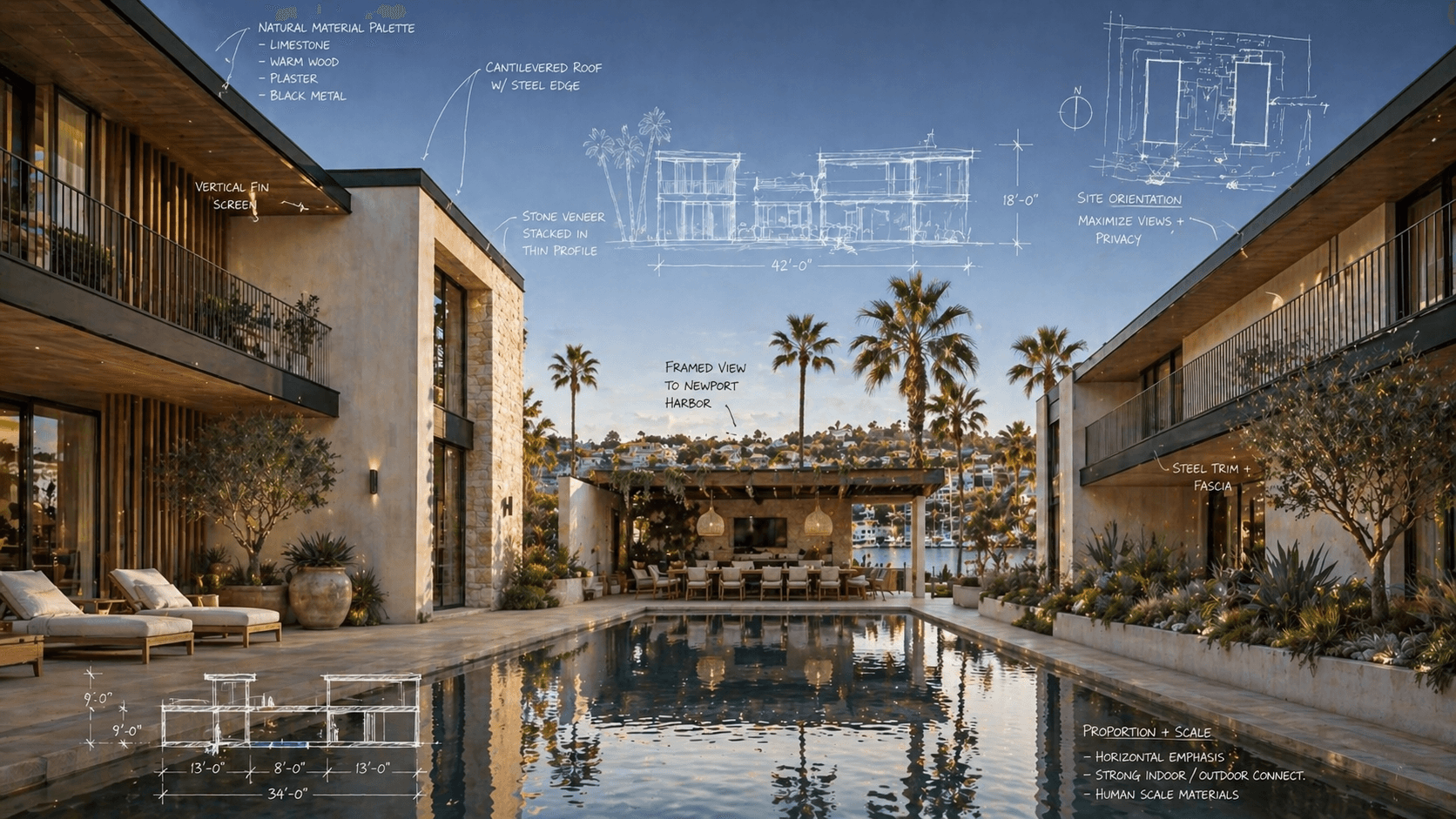
Architect-Builder Misalignment Costs Homeowners Millions
Read Article
Why do luxury home projects consistently run over budget and behind schedule? The answer isn't poor craftsmanship or unrealistic designs. It's structural misalignment.
In residential construction, architects and builders operate as separate firms with different contracts, different incentives, and different liability exposure. Yet homeowners expect them to function as a single delivery system from design through completion.
When that system works, projects feel controlled and predictable. When it doesn't, owners face cost overruns, design rework, and schedule delays. Most projects are set up for misalignment from the start.
Where Design and Execution Diverge
On paper, the division of labor is clean. Architects handle design intent, spatial planning, and code compliance. Builders manage execution, sequencing, labor, procurement, and site conditions. In practice, those responsibilities overlap constantly.
A detail that works aesthetically may be impossible to build. A material substitution that solves a sourcing issue may undermine a design goal.
These are normal friction points of construction. The issue is when they surface too late to resolve efficiently.
"Once drawings are complete and permits submitted, flexibility drops," said Sabrina Sofia, design coordinator of ARCA Builders. "Decisions that should have been resolved during design get pushed into the field through costly change orders."
The Case for Early Involvement
The most important architect-builder coordination happens before construction begins. When builders are brought in during schematic design or early design development, they can pressure-test ideas against current pricing, trade availability, and sequencing.
That input protects design quality by aligning ambition with execution.
"We've seen projects where the design was beautiful on paper, but the documentation assumed conditions that didn't exist on the site," said Jeremy Lepine, CEO of ARCA Builders. "By the time those issues were discovered, the options were limited and expensive."
This dynamic is especially pronounced in luxury residential construction, where projects are less standardized and more sensitive to detail. Long-lead materials, custom assemblies, and site-specific constraints introduce risks that aren't visible in drawings alone.
A builder with experience in high-end work can identify those risks early and force the right conversations before they become expensive problems.
Common Pressure Points
Even on well-managed projects, certain fault lines recur.
One is constructability. Architects design systems; builders assemble them. When those systems involve tight tolerances, concealed conditions, or complex structures, coordination must be explicit. Assumptions made by either side tend to surface later as rework.
Substitutions are another flashpoint. Builders are often tasked with maintaining schedule and budget in a volatile supply environment. Architects are responsible for preserving performance and intent. Without a clear framework, substitution requests can feel adversarial rather than practical.
Requests for Information (RFIs) are the third friction point. Builders need timely answers to keep work moving. Architects need sufficient context to respond responsibly. When communication protocols are unclear, simple questions can stall entire sequences of work.
What differentiates successful projects is the speed and clarity with which conflicts are resolved, not their absence.
The Owner's Role in the Equation
Owners often assume that hiring good professionals guarantees good collaboration. But alignment is created by structure, not goodwill.
Clear expectations around early builder involvement, documented constructability reviews, defined decision authority, and regular coordination meetings materially reduce friction. When those expectations are absent, architects and builders are forced to protect their own scopes first, even when they want to collaborate.
Owners set the tone through how they handle changes. Late-stage revisions without acknowledgment of schedule or cost impacts strain the relationship between design and construction teams. Owners who respect the process get better outcomes from it.
Why This Matters in Southern California's Luxury Market
High-end residential projects raise the stakes across the board. Design complexity increases. Client expectations sharpen. Margin for error shrinks.
In markets like Newport Beach, Pacific Palisades, and Malibu, where custom homes involve complex coastal engineering, hillside foundations, and strict local regulations, the cost of architect-builder misalignment multiplies.
The builder must integrate design, trades, procurement, and sequencing. That requires working alongside architects as collaborators, anticipating needs rather than simply responding to directions.
Experienced luxury builders understand where drawings end and execution begins. They know which details demand mockups, which materials require early deposits, and which assemblies fail most often when rushed. That knowledge isn't theoretical. It's operational.
When builders bring that perspective early, and architects are open to it, collaboration shifts from compromise to refinement.
What Actually Works
The difference between a smooth project and a strained one comes down to intentionality.
Industry studies show that integrated design-build teams experience fewer change orders and faster project completion than traditional sequential delivery, with typical cost savings of 12-15%.
Projects perform better when builders are involved before decisions harden, communication pathways are explicit, and both parties respect the constraints the other is managing.
At ARCA Builders, this is why we enter projects during schematic design, not after permits are pulled. We focus on early constructability review and disciplined execution so design intent survives contact with the field. The result is fewer surprises, clearer decisions, and projects that move forward with control rather than correction.
Details
Date
Category
Resources
Reading Time
7 min